Reverse osmosis is widely used to reduce dissolved salts and selected impurities in water. However, an RO plant should never be selected only by its advertised litres-per-hour capacity.
The correct system depends on raw-water chemistry, treated-water purpose, operating hours, recovery expectations, storage requirements, and wastewater management. Commercial buyers comparing an RO water treatment system supplier should expect a recommendation supported by water analysis and process calculations.
Define the Intended Use
The required water quality changes according to the application. Drinking water, boiler feed, industrial rinsing, food production, hospitals, laboratories, and hospitality operations may have different treatment objectives.
Before requesting a proposal, define:
- Daily treated-water demand
- Peak hourly requirement
- Operating schedule
- Source of raw water
- Required product-water quality
- Available feed pressure
- Storage capacity
- Space and drainage
- Future expansion
- Applicable hygiene or process standards
A restaurant may need a smaller drinking-water plant, while a factory may require continuous operation with automated monitoring.
Begin with a Laboratory Water Test
At minimum, the analysis may need to examine total dissolved solids, hardness, pH, turbidity, alkalinity, iron, silica, chloride, and microbiological condition where relevant.
Testing helps determine the pretreatment required to protect the RO membranes. Without adequate pretreatment, membranes can foul, scale, or lose output prematurely.
Understand the Treatment Stages
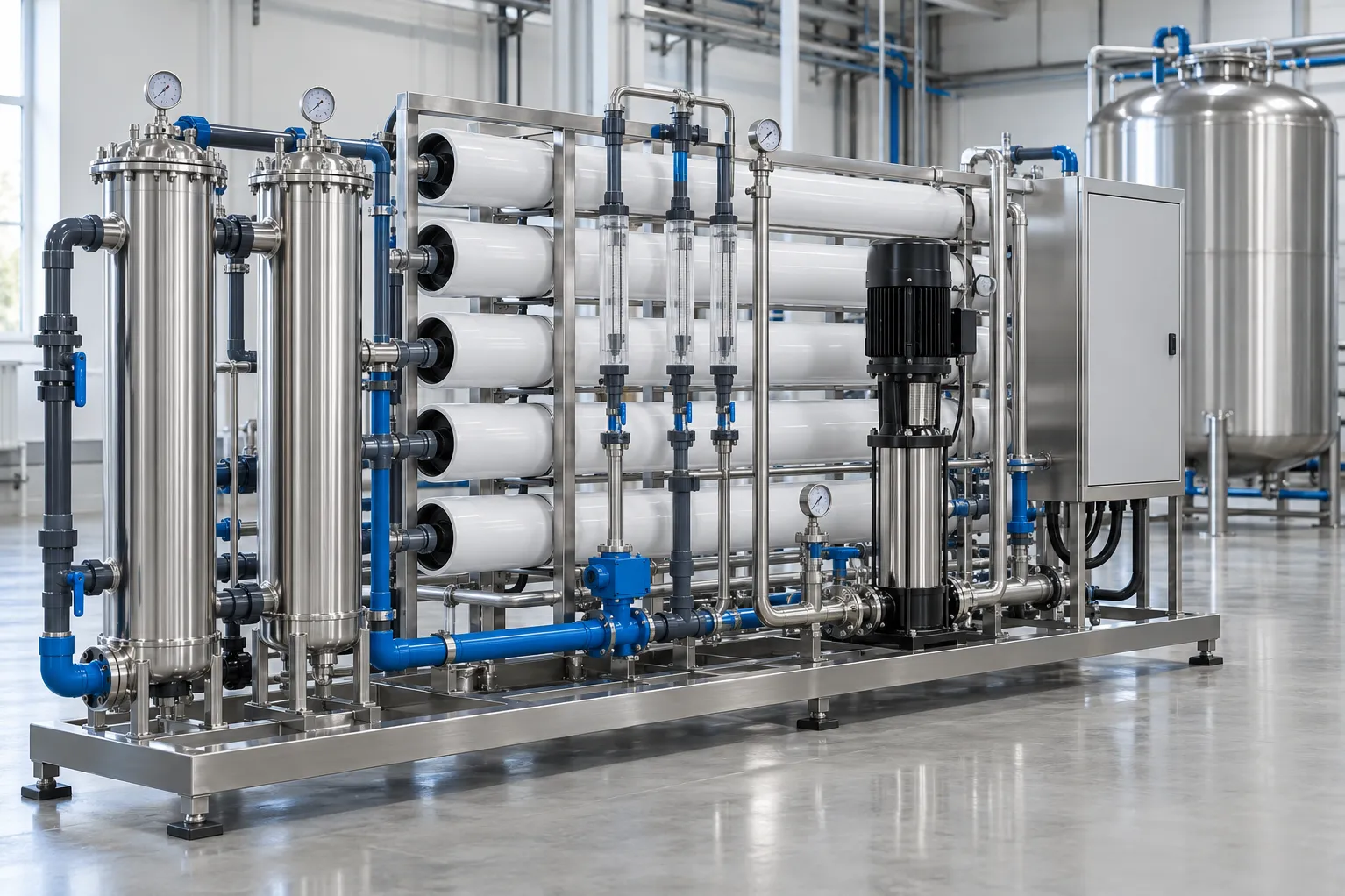
A commercial RO system may include:
- Raw-water storage
- Feed pump
- Multimedia filtration
- Activated carbon filtration
- Water softening or antiscalant dosing
- Cartridge filtration
- High-pressure pump
- RO membrane assembly
- Product-water storage
- Disinfection or polishing where required
Not every site needs the same stages. For example, chlorine may need to be removed before certain membrane types, while iron-rich borewell water may require specialised pretreatment.
Compare Output with Recovery
If an RO system receives 1,000 litres of feed water and produces 600 litres of treated water, the remaining quantity exits as reject or concentrate. The relationship between product water and feed water is known as recovery.
Higher recovery may reduce reject volume, but it can also increase scaling risk when water chemistry is unsuitable. The supplier should explain the recommended recovery rate and the assumptions behind it.
Where feasible, reject water may be assessed for appropriate non-potable applications. Reuse should depend on its quality and local operational requirements.
Examine Automation and Monitoring
Commercial systems benefit from instruments that help operators detect changing conditions.
These may include:
- Feed and product flow meters
- Pressure gauges
- Conductivity or TDS monitoring
- Low-pressure protection
- High-pressure shutdown
- Tank-level controls
- Automatic flushing
- Dosing controls
- Fault indicators
- Hour meters
Operators should be trained to record readings. A gradual increase in pressure difference or decline in product flow can indicate filter blockage, scaling, fouling, or membrane deterioration.
Calculate the Total Operating Cost
The initial price does not represent the full cost of ownership. Buyers should consider:
- Electricity consumption
- Cartridge replacement
- Filter media servicing
- Membrane cleaning and replacement
- Treatment chemicals
- Softener salt
- Reject-water handling
- Operator attention
- Preventive maintenance
Two systems with the same nominal output can have different operating costs depending on recovery, pump efficiency, membrane design, and pretreatment quality.
Verify Service Capability
Commercial buyers in Noida, Ghaziabad, Greater Noida, Lucknow, and other Uttar Pradesh locations should confirm service coverage and spare-parts availability.
RISE N SHINE supplies water-treatment systems for commercial, residential, and selected industrial requirements across Uttar Pradesh and Delhi NCR. A technically responsible proposal should state the design water analysis, treatment stages, capacity, recovery, operating pressure, and expected output quality.
The clearest sign that a buyer is ready for an RO system is the availability of accurate water data and a defined end use. With proper pretreatment, monitoring, and maintenance, an RO plant can provide consistent treated water without relying on vague capacity claims.
Keywords