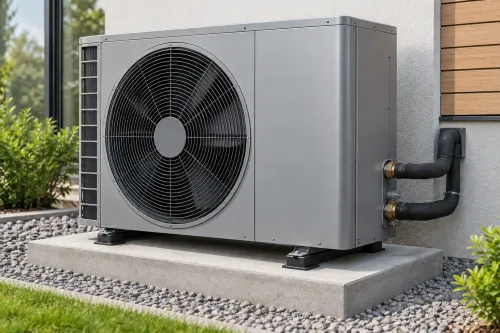
A V-Guard 500 LPD heat pump that starts and stops before the required water temperature may be operating normally, entering a protection cycle, or struggling with airflow, circulation, power, or an undersized installation. You will be able to separate those causes, record the readings a technician needs, and decide whether the problem is a control setting, a plumbing fault, insufficient recovery capacity, or a genuine equipment failure.
Key takeaways
- Confirm whether the tank reached its control temperature before resetting the unit.
- Check power supply, airflow, filters, error codes and water temperature readings.
- Ask the technician to test sensors, refrigerant pressure, compressor operation and circulation.
- Compare demand, recovery time and installation records before replacing an undersized system.
Is the early stop normal or a heat-pump fault?
A thermostat cut-out is normal when the tank reaches its control temperature; an early fault stops the compressor while the tank still needs heat. If you searched “v guard 500l heat pump for stopping early in delhi” or “v guard heat pump not heating”, identify the stop before resetting the unit.
1. Record the controller error code, displayed tank temperature, setpoint, differential, timer schedule, auxiliary-heater setting, and exact time the compressor stops. A timer or load-management contactor can interrupt recovery before the setpoint, while thermostat control stops the compressor after reaching it.
2. Treat a brief pause in cold, humid weather as possible defrost operation. Repeated or prolonged defrosting requires inspection of the outdoor coil, fan, airflow, and controls.
3. Check protection cycling rather than assuming a failed compressor. High-pressure protection can follow blocked airflow, high ambient temperature, or poor water circulation. Low-flow protection can follow a closed valve, blocked strainer, air lock, or failed circulation pump.
4. If the compressor stops at the same displayed temperature while delivered water remains cool, ask the technician to check sensor position, insertion depth, calibration, tank stratification, mixing valves, non-return valves, reverse flow, and cold-water cross-connections. The display may show a warm upper layer while colder water remains below.
A stored fault code and measured temperatures are more useful than repeated resets. Do not bypass high-temperature or flow protection.
What should you check when the unit starts and then stops?
Do not keep resetting the unit. A stored protection fault can disappear from view, while the cause remains. Start with observation and record what happens.
1. Check that the controller has power and record any error code that remains stored. Note the setpoint, timer window, maximum water-temperature limit, differential, and auxiliary-heater setting. Check whether an external contactor or load-management device is interrupting the supply.
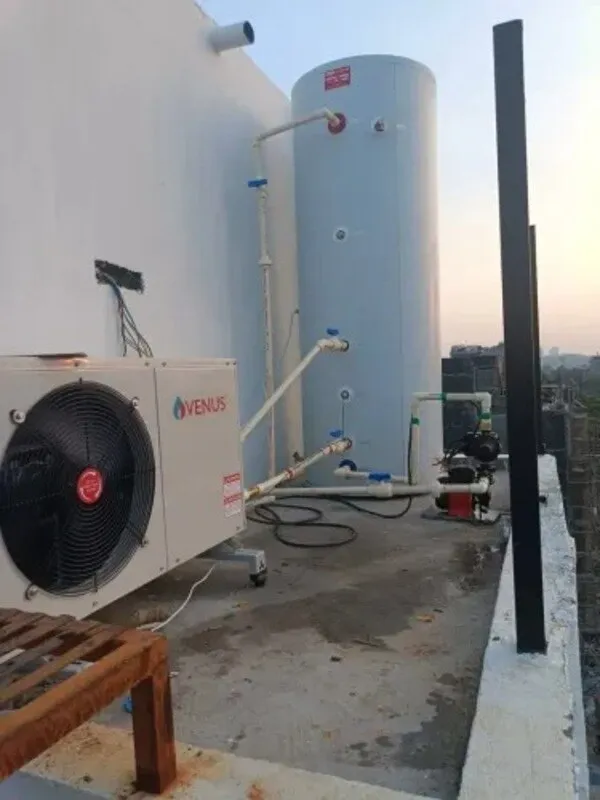
2. Listen for the compressor and outdoor fan. If the fan runs, inspect its discharge for dust, packaging, walls, or other obstructions. A blocked coil or discharge can create a 500 L heat pump water heater problem.
3. Confirm that the circulation pump runs, every isolation valve is open, the inlet strainer is clean, and the flow switch proves circulation. An air lock, closed valve, or failed pump can stop heat transfer and trigger protection.
4. Run one continuous heating cycle and measure temperature at the tank inlet, tank outlet, and heat-pump water connections. Confirm that tank temperature rises over time; do not rely on one infrared reading from the casing.
5. Record every MCB or RCCB trip, supply voltage during compressor start and operation, phase loss or imbalance where applicable, terminal heating, earthing, and overload protection. A V Guard heat pump not heating needs electrical evidence, not repeated resets.
Never bypass high-temperature protection. If the compressor runs but water does not heat, check airflow and water circulation before anyone adds refrigerant.
Which Delhi conditions can make heating stop early?
Winter air reduces the heat available to the compressor, so recovery takes longer. Cold incoming water adds to the heat load. A V-Guard 500L heat pump stopping early in Delhi can therefore reflect site conditions rather than an immediate component failure.
| Condition | What changes | What to inspect |
|---|---|---|
| Winter air | Less available heat and slower recovery | Ambient temperature and heating time |
| Cold inlet water | More energy required to reach setpoint | Tank inlet temperature |
| Rooftop dust or tight clearance | Restricted airflow raises operating stress | Filter, evaporator coil, fan discharge and unit clearance |
| High ambient temperature | High-pressure protection can stop the compressor | Outdoor airflow and stored error code |
| Monsoon moisture | Coil frosting increases defrost demand | Icing and repeated defrost pauses |
| Voltage fluctuation | Electrical protection can stop the compressor | Supply voltage during start and operation |
Ask the technician to record:
- Cold-water inlet temperature, tank temperature, controller setpoint, discharge temperature, ambient temperature, compressor current, supply voltage, error code, and time taken for the temperature to rise.
- Temperatures at the tank inlet, tank outlet, and heat-pump water connections during continuous operation.
Interpret every reading against the V-Guard manual and service data. Do not accept a universal “normal” temperature rise, pressure, current, or refrigerant charge for this model. For commercial heat pump repair in Delhi, provide this sheet before parts or refrigerant are proposed.
Could the 500 LPD system be undersized or incorrectly installed?
Yes—the 500 LPD system can be undersized or incorrectly installed. “500 LPD” describes a daily hot-water capacity or application rating, not instant production of 500 litres of hot water.
Heating 500 litres from 20°C to 55°C requires about 20.3 kWh of heat before tank and pipe losses. Recovery time is approximately 20.3 divided by the heat pump’s actual thermal output in kilowatts, so 3 kW requires about 6.8 hours before defrost or winter derating.
| Condition | What it suggests | What to check |
|---|---|---|
| Demand exceeds recovery | Capacity or storage mismatch | Daily draw-off, peak demand, simultaneous showers, kitchen use, and design figures |
| Warm stratified layer | Sensor ends heating early | Sensor position, insertion depth, calibration, and tank temperatures at multiple levels |
| Heat reaches tank slowly | Installation or flow loss | Insulation, pipe sizing, recirculation losses, valves, and circulation flow |
Ask the site manager to compare incoming-water temperature, target temperature, available storage, and user draw-off with the planned design. Check mixing-valve settings, non-return valves, reverse flow, cold-water cross-connections, and whether users draw water during recovery.
A 500l heat pump water heater problem can appear to be a failed compressor or controller when demand exceeds recovery or a sensor reads a warmer layer. Confirm the actual tank temperature and plumbing condition before condemning the heat-pump module.
What should you request from a Delhi heat-pump service technician?
Before any part is replaced, ask the technician to prove what stops the V-Guard 500 LPD system: control logic, water circulation, airflow, electrical supply, or refrigeration. A service request without these readings invites a sensor swap or refrigerant charge that never addresses the fault.
- Model and serial number
- Refrigerant named on the equipment nameplate
- Stored error code, setpoint, and exact compressor-stop time
- Measured tank temperature and cold-water inlet temperature
- Compressor current and supply voltage while running
- Outdoor-coil condition: clear, frosted, or fully iced
- Water flow, pump operation, open isolation valves, and clean strainer
- Sensor position, insertion depth, and calibration result
For commercial heat pump repair in Delhi, reject a quote that says only “refrigerant top-up.” Require leak testing before charging, evacuation, and weighing in the nameplate-specified refrigerant charge. The technician must check operating pressures against the manufacturer’s test conditions and record final temperature rise and electrical current.
| Finding | What it points to | Required next step |
|---|---|---|
| Normal setpoint cut-out | Control operation | Verify sensor calibration and delivered-water temperature |
| Low flow with high temperature rise | Pump, valve, strainer, or air lock | Restore circulation before refrigeration work |
| Iced coil or restricted airflow | Fan, filter, clearance, or defrost fault | Correct airflow and confirm defrost operation |
| Low rise with normal current and flow | Refrigeration-side fault | Leak-test and verify charge and pressures |
Give this measurement sheet to a local provider such as RISE N SHINE for V-Guard heat pump service in Delhi. Ask for written findings on airflow, circulation, controls, plumbing, electrical supply, and capacity, then compare repair with redesign or added storage.
Related product
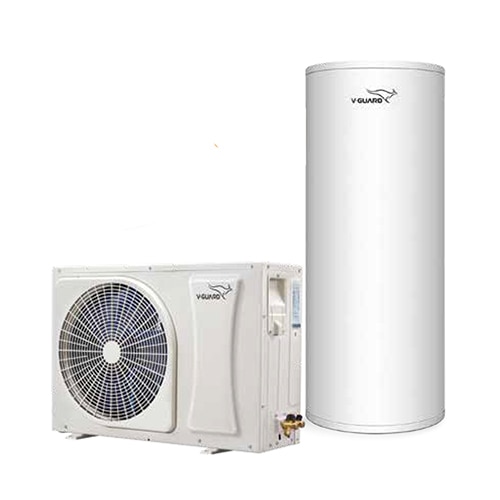 | Electric Water Heater V-Guard 500 LPD Heat Pump water Heater ₹226500 V-Guard 500 LPD Heat Pump Water Heater The V-Guard 500 LPD Heat Pump Water Heater is a high-capacity, energy-efficient hot water solution designed... View product → |
Frequently asked questions
Is an early stop normal or a heat-pump fault?
A thermostat cut-out is normal when the tank reaches its control temperature. It indicates a fault when the compressor stops while the tank still needs heat, especially alongside an error code, abnormal noise or unchanged water temperature.
What should you check when the unit starts and then stops?
Record the start and stop times, tank temperature and display code. Check the power supply, isolator, airflow around the outdoor unit, blocked filters and water circulation before restarting repeatedly.
Which Delhi conditions can make heating stop early?
High ambient temperatures, dust-clogged filters, restricted airflow, voltage fluctuations and hard-water scale can trigger protective controls or reduce heat transfer. Check the unit’s operating readings rather than assuming the climate caused the stop.
Could a 500 LPD system be undersized or incorrectly installed?
Yes. A 500 LPD system can struggle when occupancy, peak hot-water demand, pipe losses or recovery-time assumptions exceed its design. Incorrect sensor placement, poor circulation, inadequate airflow and undersized electrical supply can also cause incomplete heating.
What should you request from a Delhi heat-pump service technician?
Request a written diagnosis covering error codes, supply voltage, sensor readings, compressor current, refrigerant pressure, airflow, water circulation, tank temperature and the recommended repair. Ask for the service report and a clear distinction between a component fault and insufficient capacity.
Keywords