Hotels and hospitals cannot treat hot water as an occasional convenience. Guest comfort, patient care, cleaning, kitchen operations, and laundry services may all depend on its uninterrupted availability.
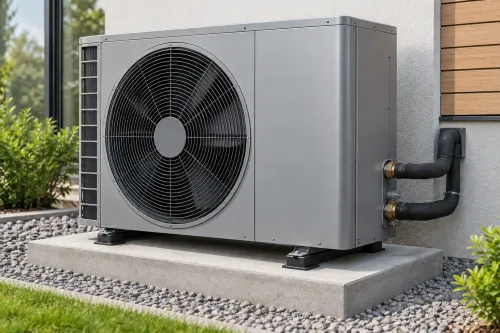
A commercial heat pump water heater can reduce reliance on conventional electrical heating, but commercial success requires much more than installing a high-capacity unit. Demand patterns, tank sizing, circulation, water quality, controls, and backup arrangements must be planned as one integrated system.
Start with a Hot Water Demand Profile
Daily consumption alone does not provide enough information. A hospital using 8,000 litres over 24 hours has a different requirement from a hotel using the same quantity primarily between 6 a.m. and 10 a.m.
A useful demand profile identifies:
- Total daily hot water consumption
- Maximum demand during one hour
- Required delivery temperature
- Number of simultaneous outlets
- Occupancy or bed capacity
- Laundry and kitchen consumption
- Seasonal changes
- Current system performance
- Future capacity additions
Properties in Noida, Ghaziabad, Lucknow, Agra, and other Uttar Pradesh cities should have their operational requirements assessed individually.
Match Heating Capacity with Storage
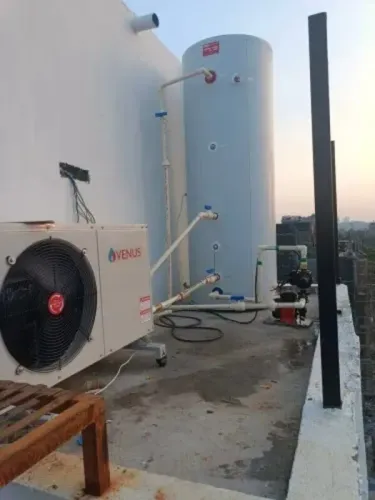
Commercial heat pumps usually work with insulated storage tanks. The heat pump heats water over time, while the tank helps meet periods of concentrated consumption.
A larger tank is not automatically the best solution. Excessive storage can occupy valuable space and increase standing heat loss. Insufficient storage may cause temperature drops during peak usage.
The system designer must balance:
- Heat pump output
- Storage volume
- Recovery time
- Peak demand
- Available operating hours
- Standby heating capacity
Multiple heat pumps may be used in modular arrangements for larger properties. This can support staged operation and provide partial continuity if one unit is temporarily unavailable.
Consider the Distribution Network
Hot water loses heat as it travels through a building. Long pipe routes, inadequate insulation, poor balancing, and continuous circulation can increase the load placed on the system.
A well-designed network should consider:
- Correct pipe diameter
- Thermal insulation thickness
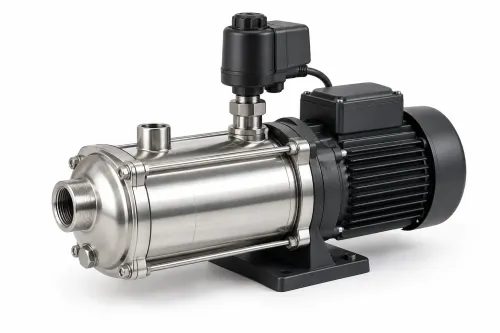
- Circulation pump capacity
- Balancing of multiple branches
- Location of storage tanks
- Distance to the farthest outlet
- Temperature monitoring
- Prevention of stagnant sections
Hospitals may also have specific hygiene and temperature-control protocols. The final design should align with the facility’s operational and plumbing requirements.
Plan for Water Quality
Many areas of Uttar Pradesh experience hard water. Mineral deposits can form inside tanks, heat exchangers, valves, and pipelines, reducing heat transfer and restricting flow.
Water testing should be completed before finalising the system. Depending on the results, treatment may include filtration, automatic softening, or another appropriate conditioning process.
Routine inspection is equally important. Even when a treatment system is installed, salt levels, regeneration cycles, filters, and hardness at the outlet need to be monitored.
Protect Operations with Backup Heating
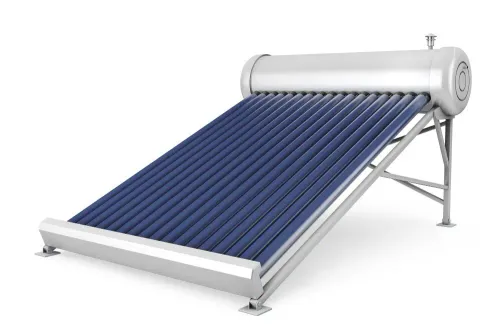
A commercial property should have a plan for unusual demand, extreme weather, scheduled maintenance, or equipment interruption. Backup heating may be integrated through electrical elements, boilers, solar support, or an existing system.
The objective is not to operate backup heating continuously. It should support the main arrangement only when necessary.
Controls can be configured to manage:
- Heat pump operating schedules
- Tank temperature
- Staged equipment operation
- Backup heater activation
- High-temperature protection
- Low-flow conditions
- Fault alerts
Assess Installation Space Early
Heat pumps require airflow and maintenance access. The equipment area should not be selected only after plumbing construction is complete.
Architects, builders, and MEP consultants should allocate space for:
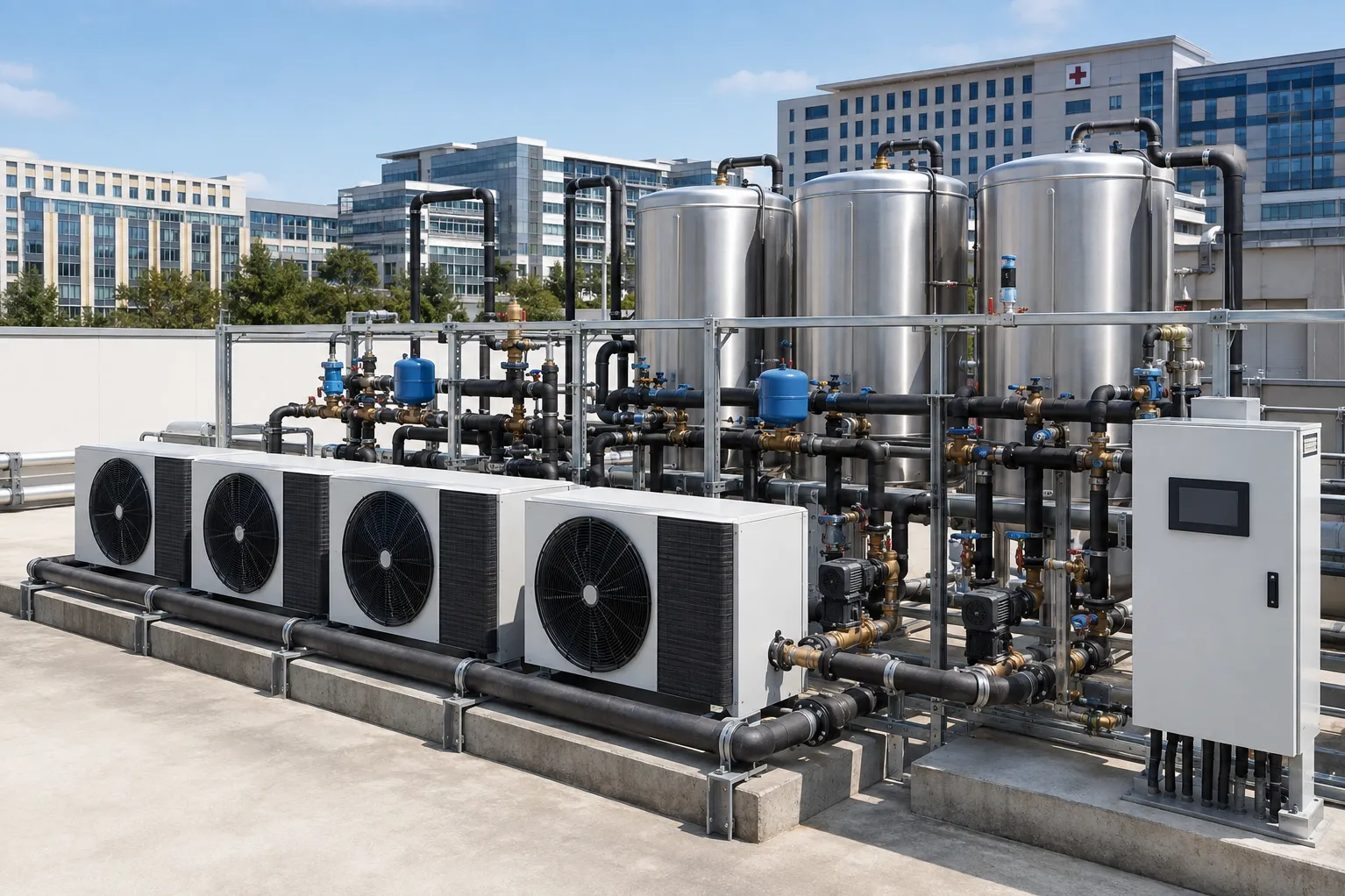
- Heat pump units
- Insulated tanks
- Circulation pumps
- Control panels
- Water-treatment equipment
- Drainage
- Service clearances
- Pipe connections
Early coordination can prevent congested installations and expensive changes during commissioning.
Measure Value Through Operating Performance
Commercial buyers should compare systems using projected energy use, hot water output, service availability, maintenance requirements, equipment quality, and expected operational life. Claims based on ideal laboratory conditions should be reviewed against the actual installation environment.
RISE N SHINE supports commercial hot water planning for hotels, hospitals, builders, and facility managers across Uttar Pradesh and Delhi NCR. A successful commercial heat pump water heater installation begins with accurate data and ends with consistent monitoring after commissioning.
When heating equipment, storage, circulation, treatment, and controls are properly coordinated, a commercial heat pump system can provide reliable hot water while improving energy management across the property.
Keywords